


Prostatitis is an inflammatory process in the tissues of the prostate gland.Today, approximately 30% of men suffer from prostatitis after the age of 30, and this figure increases with age.This disease is much easier to prevent than to treat, so it is important to know the causes of prostatitis, the symptoms of its acute and chronic forms and ways to prevent complications such as adenoma and prostate cancer.
The main causes of prostatitis
The clinical picture of prostatitis includes a wide range of symptoms related to the body's systemic response to the inflammatory process.The most common and significant are problems with urination and disorders of sexual life.The degree of manifestation of the symptoms of prostatitis has a multifactorial nature, i.e.it depends on many factors: the individual characteristics of the man's body, the state of the prostate and the presence of concomitant pathologies, the man's lifestyle, smoking, alcohol abuse and the activity of the immune system.
Experts distinguish two main types of disease, on which further treatment will depend:
- Infectious.Inflammation is associated with the pathogenic action of microorganisms.
- At a standstill.Inflammation is associated with blood stagnation, hypoxia (lack of oxygen) and manifestation against the background of ischemia and alteration (damage) and remodeling of the gland, replacement of functionally active connective tissue.
Often one form of the disease passes into another.The infectious process affects blood vessels and disrupts local blood circulation, causing stagnation;on the other hand, the initial stasis reduces the ability of the immune system to fight the developing infection locally because it reduces the rate of blood transport of immunocompetent cells to the lesion.Prostatitis occurs in acute and chronic form.More often, specialists encounter the first - its symptoms are quite characteristic, so the process can be slowed down and further development can be completely prevented.
If the disease is not treated properly, it can become stationary and then chronic.During an exacerbation of prostatitis, a man experiences a general deterioration of health, pain appears in the lower back, in the groin area, the urination process is disturbed, the body temperature rises.
Spicy
The acute pathological process, unlike the chronic one, appears suddenly and has clear clinical symptoms that force a person to see a doctor.The body temperature rises to 39 degrees, the man experiences severe pain in the lumbar region.The highest incidence point is between the ages of 30 and 40.
The cause of the pathological process are infectious foci that can be located in distant organs.The causative agent of the disease can penetrate the prostate gland both ascending rectally or through the urethra, and descending hematogenous (through the blood) and lymphogenic (through the lymph).
The type of pathogen directly affects the therapy performed:
| A pathogen | Frequency of occurrence | Gram stain (necessary to select antibiotic therapy) |
|---|---|---|
| Escherichia coli | often | GR- |
| Pseudomonas aeruginosa (Pseudomonas aeruginosa) | often | GR- |
| Klebsiella spp. | often | GR- |
| Enterococcus faecalis | often | GR+ |
| Proteus (Proteus mirabilis) | often | GR- |
| Serratia marcescens | Rarely | GR- |
| Chlamydia (Chlamydia trachomatis) | often | GR- |
| Staphylococci (Staphylococci spp) | Rarely | GR+ |
| Enterobacteriaceae | Rarely | GR- |
| Ureaplasma (Ureaplasma urealyticum) | Rarely | GR- |
| Gonococci (Neisseria gonorrhoeae) | Rarely | GR- |
| Mycoplasma (Mycoplasma hominis) | Rarely | Mollicutes |
| Candida (Candida spp) | Rarely | mushrooms |
| Trichomonas | Rarely | Protozoa |
Prostatitis can be caused by:
- intestinal and urological infections;
- infectious diseases of the genital area;
- diseases of the upper and lower respiratory tract.
Often the cause of inflammatory lesions of the internal organs is caries.
The ascending route of infection from bacteria, fungi and protozoa is when they enter the prostate tissue from the urethra and rectum.More often, the lesion is associated with urological infections, such as:
- urethritis (inflammation of the urethra);
- cystitis (bladder inflammation);
- pyelonephritis (inflammation of the renal pelvis).
Sexually transmitted diseases often become the main cause of inflammation of the prostate gland, the most common of which is gonorrhea.The formed pathological focus, located in close proximity to the prostate, easily spreads in the prostate tissue.To prevent such diseases, it is important to practice safe sex.
The downward path of spread of the pathogen consists in its penetration from the primary focus into the prostate lymphogenously and hematogenously.The source of infection can be a pathological process in the throat (sore throat), in the upper and lower respiratory tract (bronchitis, flu) or in the oral cavity (caries).
Disseminated or hematogenous tuberculosis.The first symptoms appear 2-3 weeks after the main disease.Collecting an epidemiological history is an important component of the diagnosis.
Immune status plays an important role in the incidence of prostatitis.Not all men exposed to infectious diseases develop prostatitis.If the immune system suppresses the development of a pathogenic microorganism, then the process in the tissue of the gland stops without the appearance of pathology.On the other hand, weakened immunity leads to complications.The prostate gland is a vulnerable organ that is located near potential entry points for infection, so it is the first to be negatively affected by microbes.
Chronic
If acute prostatitis is not treated, a chronic process develops.The symptoms of this form of pathology are less pronounced, the general condition is satisfactory, the temperature is normal.That is why men do not consider such a pathological process dangerous and postpone a visit to a doctor.
Like any chronic disease, prostatitis occurs in stages of remission and exacerbation.In a chronic course, the inflammation of the prostate tissue is slow, and therefore the symptoms may not be fully manifested.They will only intensify at the time of exacerbation.
The chronic pathological process causes deterioration of the innervation of the organ, which leads to disorders of the trophism (nutrition) of the organ, which negatively affects its function.It is also possible to develop an autoimmune reaction.A person's own immune system produces antibodies against prostate cells.In this case, the inflammation will persist even after the pathogenic microorganism has been completely eliminated.
At a standstill
Non-infectious inflammation of the prostate occurs due to congestion in the pelvis.The disease develops progressively and over time the intensity of the symptomatic complex increases.This form of prostatitis is the most common today.
The main reason is dyscirculatory phenomena, which lead to the fact that blood does not flow from the pelvic area, so all the organs located in this area do not receive enough nutrition and adequate oxygenation.The flow of secretions is impaired and degeneration of the muscles of the pelvic diaphragm occurs.The most important cause of stagnation is an inactive lifestyle.Injuries also contribute to stagnation.Diabetes mellitus through macro- and microangiopathy can reduce blood flow to the pelvic organs.
Causes of congestive inflammation of the prostate:
| Etiological factor | Pathogenesis |
|---|---|
| Low level of physical activity | Experts consider it the most common cause of congestive prostatitis.This is facilitated by the increasing influence of technological progress on human life: escalators, elevators, cars.Low physical activity leads to a breakdown of the muscle pump mechanism that helps the blood drain from the organs.Prevention is movement, sports, walks |
| Bad nutrition | It negatively affects all body systems and especially the regulation of the vascular system due to local and systemic factors |
| Overweight | Obesity is one of the components of the metabolic syndrome, which also includes hypertension, dyslipidemia, and diabetes mellitus.One component has a beneficial effect on the likelihood of development of the others, all of which lead to vascular insufficiency and stasis |
| constipation | An increase in the volume of the rectum leads to compression of the veins and impaired outflow |
| Sedentary lifestyle (common among drivers and office workers) | Sitting in a chair, a person does not change his position for a long time.As a result, compression of individual venous vessels and local congestion occurs.Prevention is a change in the sitting position and periodic gymnastics, walks |
| Irregular sex life | It leads to stagnation not only of the blood, but also of the prostatic secretion.As a result of metabolic processes, the secretion can turn into a poison and cause a systemic toxic effect.Excessive sexual activity is also harmful to the man, as it leads to exhaustion of the nervous and hormonal system, loss of nutrients, hyperfunction of the gland and depletion of its regenerative properties. |
| Frequent restraint of the urge to urinate | The prostate is an additional sphincter in the male body.Its overexertion leads to an increase in the volume of muscle tissue and a decrease in the volume of glandular tissue.In addition, the enlarged bladder puts pressure on the veins, which impairs drainage |
| Smoking and alcohol abuse | Smoking and alcohol lead to dysregulation of vascular tone |
| Lumbar trauma | Trauma often damages the prostate gland itself or important neurovascular bundles.This will disrupt the trophism of the gland and reduce blood flow |
| Excessive nervous tension, stress and depression | They lead to exhaustion of the nervous regulation of vascular tone.Hormonal imbalance develops, which leads to disruption of gland regulation (prostate adenoma development) and systemic hemocirculation. |
| Features of the development and structure of the organs of the genitourinary system | It can make the gland more likely to become infected or remodel |
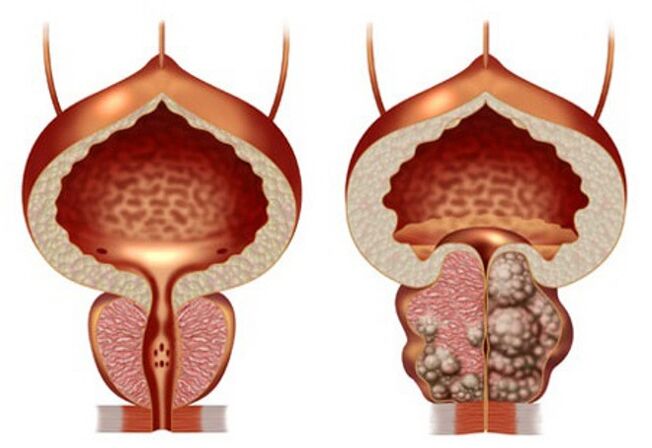
All these causes have a destructive effect on the circulatory system, both local and general.
If a person feels that he has problems urinating, starts going to the toilet more often, has pain in the lower back and groin when urinating, then he should consult a urologist.
Age effect
Experts believe that prostatitis is a disease that more often manifests itself in old age, but recently the percentage of young people with this pathology is increasing.According to unofficial statistics, based on a comparison of data from diagnostic cases and research, about 16% of men aged 20 to 40 are officially diagnosed with chronic prostatitis.
Taking the indicators of men from 20 to 39 years as a basis, the experts found that the statistical incidence of prostatitis in the age range from 40 to 49 years is 1.7 times higher, and for those over 55 years - 3.1 times higher.However, the statistics only take into account identified patients.However, the official statistics have a noticeable error, and the methods for diagnosing prostatitis are not sufficiently developed.
Diagnosis and treatment
The method of treatment depends directly on the cause of the disease, so the most important point is the diagnosis, which includes:
- Collection of life history and epidemiological history.
- Ultrasound.
- Rectal digital examination.
- Bacteriology of prostatic secretion.
- PSA level - analysis (necessary to rule out prostate adenoma and prostate cancer).
- Urine tests.
- General and biochemical blood test.
Treatment of prostatitis is effective through a combination of the following methods:
- Pharmacological treatment.Medicines are selected, as a rule, exhaustively.
- Medical massage.
- Physiotherapy.Medicinal electrophoresis, darsonvalization, UHF therapy, etc.
- Gymnastics and an active lifestyle.
- People's funds.The use of various herbal preparations that are sold in pharmacies.
You should not prescribe pills yourself or practice traditional medicine without consulting a specialist.Many of the drugs and herbs used to treat prostatitis are systemic and contraindicated in some patients.
Do not forget about prevention, which includes eliminating harmful factors and leading an active lifestyle.